A sinkhole opens overnight in your parking lot. A section of asphalt buckles under the summer heat and a tenant's car drops into a pothole the size of a cooler. A delivery truck clips the edge of a failed section and cracks it apart. These aren't slow-burn maintenance issues. They're emergencies, and every hour you leave them unaddressed adds liability, damage, and cost.
If you manage a commercial property in San Diego, you already know that pavement doesn't fail on a schedule. It fails at 7 a.m. on a Monday when your lot is filling up, or in the middle of a heat wave when the asphalt beneath the surface has already been cooking for weeks. Knowing what to do in those first hours makes the difference between a contained repair and a full-depth replacement.
NPG Asphalt has been doing this work since 1961. In more than six decades of paving San Diego's commercial lots, retail centers, and industrial yards, we've seen every kind of pavement failure, and we know which ones can't wait.
What Counts as a Pavement Emergency
Not every crack in your lot is a crisis, but some failures cross a line where waiting even a day or two is genuinely dangerous. A true pavement emergency is any condition that creates an immediate slip, trip, or vehicle hazard, or that will spread significantly faster if left unaddressed.
The clearest examples: potholes deeper than two inches in active driving or walking lanes; alligator cracking (the interconnected, web-like pattern that signals base failure beneath the surface) that has begun to sink or shift; edge failures where the asphalt has separated and lifted near a curb or drain; and any area where standing water is pooling over a failure and softening the base further. San Diego's summer heat accelerates all of these. Asphalt that holds together under cooler conditions can degrade rapidly when surface temperatures climb above 140°F, which happens regularly in July and August.
Raveling, the progressive loss of aggregate from the surface, can look minor early on, but once it starts in a high-traffic lane, it picks up speed. What looks like surface texture one week becomes a loose-gravel hazard the next. When you see it spreading, that's your signal to call.
The First Hour: What to Do Before You Call Anyone
Speed matters, but so does doing the right things in order. Before you pick up the phone, spend ten minutes on these steps so that when a crew arrives, they can move directly to work.
- Barricade the hazard. Use traffic cones, caution tape, or temporary signage to close the affected lane or area. If it's near pedestrian access, put a physical barrier between foot traffic and the failure.
- Photograph the damage thoroughly. Shoot from multiple angles, including close-ups of the failure pattern and wide shots that show the surrounding area and any drainage nearby. Timestamp everything. This protects you if a liability claim comes later.
- Check for water intrusion. If there's a drain nearby, confirm it's not backing up into the failed area. Water sitting on a base failure will keep expanding the damage until it's removed.
- Note the failure pattern. Is it a single pothole, or is the cracking spreading outward from a central point? Can you see any subgrade shifting or sinking? This information helps your paving crew triage the scope within minutes of arrival.
- Call a licensed, bonded paving company. Not a general maintenance crew. Pavement emergencies require hot-mix asphalt, proper compaction equipment, and someone who can tell on sight whether you're dealing with a surface issue or a base failure.
One thing to resist: the impulse to fill a pothole with cold-patch compound from a hardware store. Cold patch is a temporary stop-gap. It does not bond the same way hot-mix asphalt does, it won't hold under commercial traffic loads, and it can mask the extent of the underlying damage from a crew that arrives later. Use it only if you have no other option and need something in the hole for safety while you wait for a proper repair.
What the Repair Actually Involves
Depending on what's failed and why, emergency asphalt repairs follow one of a few paths. A crew that knows what they're doing will assess the failure before they start cutting, because the visible damage on the surface is rarely the whole picture.
Patch and Fill for Surface Failures
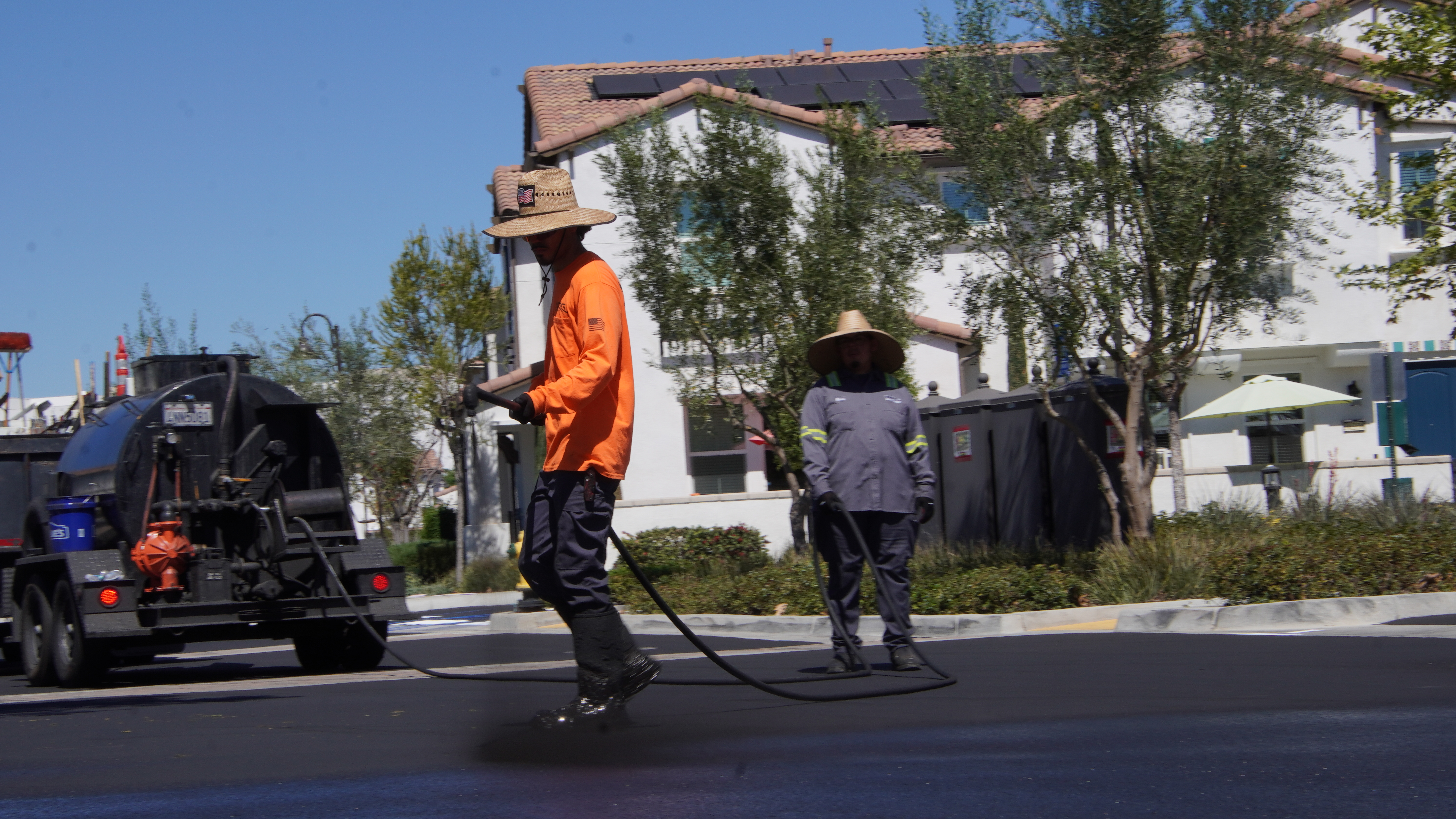
If the base is sound and the failure is limited to the top layer, a patch repair is the right move. The crew saws out the damaged section in clean, straight lines (this is called a saw-cut patch), removes the failed material, tacks the edges with a bonding coat, fills with hot-mix asphalt, and compacts it to match the surrounding grade. Done correctly, a saw-cut patch on a stable base holds well and restores a smooth, safe surface quickly. Our sealcoat and crack filling services can follow once the repair has cured, locking in the new surface and protecting the surrounding pavement from the same kind of deterioration.
Mill-and-Fill for Deeper Surface Damage
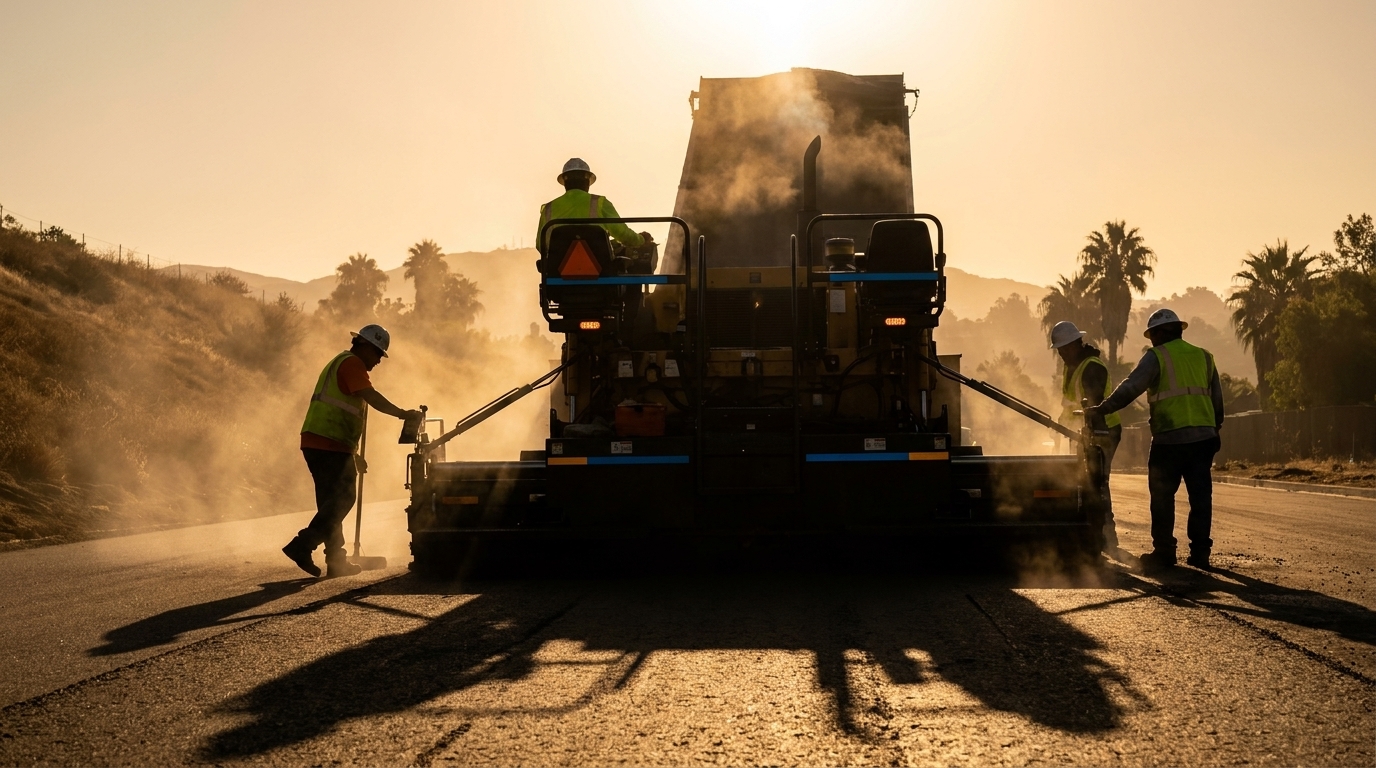
When the damage runs deeper but the base is still intact, asphalt grinding and removal of the compromised layer is more effective than patching over it. The grinder strips the failed material down to a consistent depth, and fresh hot-mix is laid and compacted. This approach works well for larger failed areas and produces a more uniform finished surface than a series of patches would.
Full-Depth Repair for Base Failures
Alligator cracking and sinking almost always point to base failure, meaning the aggregate base or subgrade beneath the asphalt has shifted, softened, or deteriorated. Patching the surface on top of a failed base is like painting over a rotted wall. The repair will fail again, often faster than the original pavement did. Full-depth repair means removing all the asphalt and the compromised base material, regrading and recompacting the subgrade, rebuilding the base, and paving fresh. It costs more upfront, but it's the only repair that actually solves the problem. Our team handles full asphalt removal and replacement when conditions call for it.
The fastest repair isn't always the cheapest one. Patching over a base failure will cost you twice: once now, and again in six months when it fails again.
How San Diego's Climate Accelerates Pavement Failures
San Diego doesn't get the freeze-thaw cycles that crack pavement in colder climates, but it has its own conditions that push asphalt to the edge. Summer surface temperatures regularly exceed 140°F in commercial lots with limited shade. At those temperatures, asphalt binder softens and the pavement becomes more susceptible to rutting under repeated heavy loads, delivery trucks, dumpsters, loading dock traffic. Areas that hold up fine through winter can deteriorate visibly in a single hot season.
UV exposure is the other factor. Southern California sunlight breaks down the binder that holds asphalt aggregate together, leading to raveling and brittleness over time. A lot that hasn't been sealcoated in three or four years is losing that protective layer, and the underlying pavement is becoming more vulnerable to surface cracking and water infiltration. Even a modest rainstorm, the kind San Diego gets in January and February, can push water into those cracks and reach the base. By summer, that water has done its work, and you're looking at a failure.
ADA and Code Compliance After Emergency Repairs
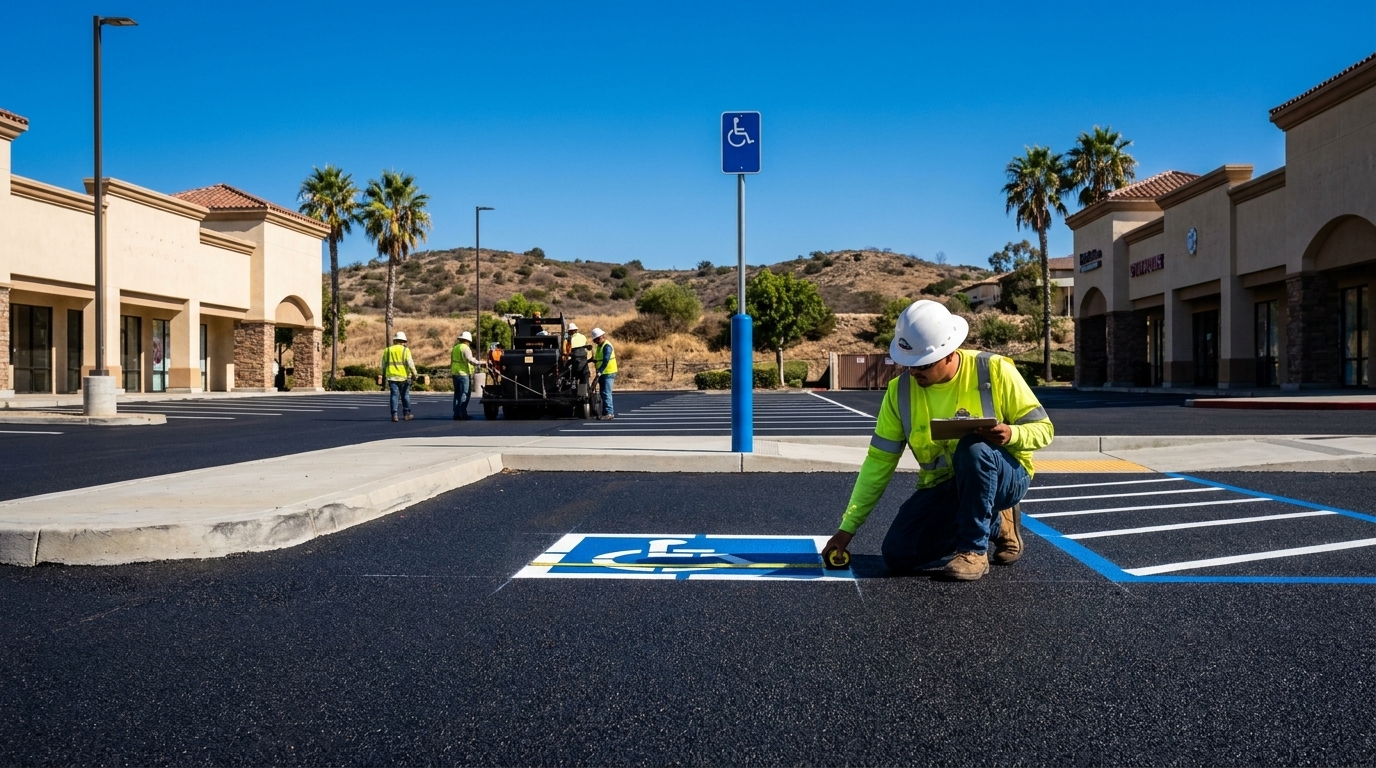
When you repair a section of pavement in a commercial parking lot, California code doesn't just expect you to fill the hole. It can trigger a requirement to bring the repaired area into current ADA compliance. This applies specifically to accessible parking spaces, access aisles, and the routes connecting them to your building entrance.
If your emergency repair touches any of those areas, the repaired surface needs to meet current slope, cross-slope, and surface-stability standards. Our team is familiar with these requirements and flags them during the assessment phase, before work begins. For a full picture of what compliance involves in your lot, the ADA parking lot compliance checklist for San Diego business owners covers the specifics. Getting this right during the repair avoids a second mobilization and a second bill later.
Striping is also part of the equation. A patched area will need its markings repainted to match the surrounding lot, including any ADA symbols, directional arrows, or stall lines that were in the repair zone. Our parking lot striping and signage work is handled in-house, so there's no coordination lag between the paving repair and the finished markings.
Choosing the Right Crew for Emergency Work
Emergency paving work is not the place to call the lowest bidder on a list. You need a crew that can show up fast, read a failure correctly on sight, and execute a repair that holds. That means a licensed and bonded paving company with real commercial experience, not a general maintenance crew with a cold-patch bucket.
Ask any company you call these questions before they arrive: Do they carry a current CA Contractors License? Can they mobilize hot-mix asphalt equipment same-day or next-day? Do they have experience with saw-cut patching and full-depth repair, not just surface fills? Will they assess the base condition before deciding on a repair method?
NPG Asphalt has been family-owned since 1961, and we've built our reputation across San Diego on exactly this kind of work. We serve commercial property managers throughout the region, including Chula Vista, El Cajon, Santee, and properties across the Inland Empire. When you call us for an emergency, you're getting a crew that has seen this failure pattern before and knows how to fix it the first time. Request a quote and our estimators will respond with specifics, not guesses. CA Contractors License on file.